Ajit Chauhan

Sunday, October 18th, 2009

promo_IMG_1847

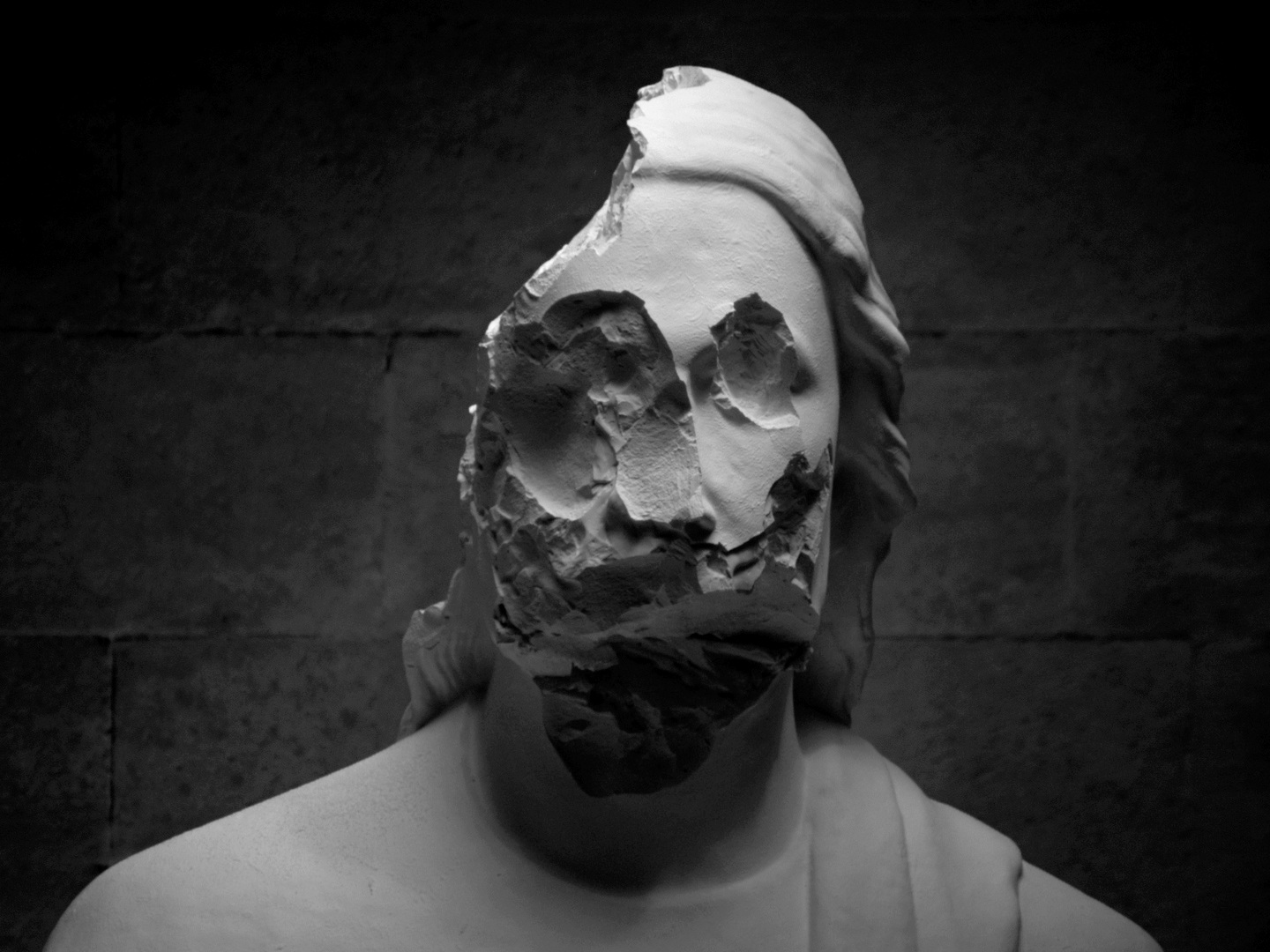
Ajit Chauhan does some art defacing by sanding out all faces of album covers… comes to you via artinfo

IMG_1823ajit_chauhan-untitled-record_cover---2009

Connected

Thursday, September 24th, 2009
Pablo Gonzalez-Trejo, Connected, 79 x 220 inches, 200 x 560 cm, 2009, Charcoal and Graphite on Canvas

Pablo Gonzalez-Trejo, Connected, 79 x 220 inches, 200 x 560 cm, 2009, Charcoal and Graphite on Canvas

Join me for a defacing performance November 4th at 7:30 pm at Le 104CENTQUATRE as part of my ongoing Defacing Art Project.

Exhibition runs from November 4th to the 8th, 2009. Vernissage opening starts at 6:00 pm

Le 104CENTQUATRE
104 rue d’Aubervilliers / 5 rue Curial 75019 Paris
M : Stalingrad (ligne 2) , Crimée ou Riquet (ligne 7)
Vélib’: bornes rue d’Aubervilliers, rue Curial, rue Riquet

Pablo Gonzalez-Trejo, Marilyn Monroe, 77 x 51 inches, 195 x 130 cm, 2009, Charcoal and Graphite on Canvas

Pablo Gonzalez-Trejo, Marilyn Monroe, 77 x 51 inches, 195 x 130 cm, 2009, Charcoal and Graphite on Canvas

Pablo Gonzalez-Trejo, JFK, 77 x 51 inches, 195 x 130 cm, 2009, Charcoal and Graphite on Canvas

Pablo Gonzalez-Trejo, JFK, 77 x 51 inches, 195 x 130 cm, 2009, Charcoal and Graphite on Canvas

Pablo Gonzalez-Trejo, Bay of Pigs, 79 x 118 inches, 200 x 300 cm, 2009, Charcoal and Graphite on Canvas

Pablo Gonzalez-Trejo, Bay of Pigs, 79 x 118 inches, 200 x 300 cm, 2009, Charcoal and Graphite on Canvas

Banksy

Thursday, August 20th, 2009
Banksy,Vandalised Phone Box_2005

Banksy, Vandalised Phone Box, 2005

Banksy defaces Hirst as well as others… Defacing art seems a strong tendancy now more than ever…

Included in the Sotheby’s auction at Larry Gagosian’s Chelsea digs, is the vandalized phone booth that Banksy installed on a street in the UK in 2005. If memory serves correct about this piece, an old lady remarked that crazy art students were always out of control. Another is a defaced Damien Hirst Pharmaceutical (spot) painting, tited ‘KEEP IT SPOTLESS’. Expect this lot (34) to break any auction record Banksy bidders had set previously. The auction, which is on Valentines Day includes many other notable lots (veritably a who’s who’s of contemporary art), including Jeff Koons, Damien Hirst, Takashi Murakami, Andreas Gursky, Tim Noble & Sue Webster, and Marc Quinn.  via TWBE

Banksy_Ruined Landscape_2007Banksy (defaced Hirst)_Keep it Spotless_2007

Greg Sand

Wednesday, August 12th, 2009
Greg Sand, Likeness, Liquid Paper on antique photographs, 11" x 14"

Greg Sand, Likeness, Liquid Paper on antique photographs, 11" x 14"

Greg Sand does some digital defacing as well as some Liquid Paper defacing to find identity… he comes to us via acido latte

Not Welcome

Saturday, June 27th, 2009
Pablo Gonzalez-Trejo, Che and Fidel, 79 x 118 inches, 200 x 300 cm, 2008, Charcoal and Acrylic on Canvas, after

Pablo Gonzalez-Trejo, Che and Fidel, 79 x 118 inches, 200 x 300 cm, 2008, Charcoal and Acrylic on Canvas, after

Please join us for an art exhibition performance on July 10th as part of the Defacing Art Project by Pablo Gonzalez-Trejo. Visitors will be invited to deface the artworks so to become iconoclasts making a new departure for the artworks.

Place: Freedom Tower – MDC Gallery
Opening Reception: Thursday, July 10th, 2009 at 6:30pm
Exhibition Runs until: Tuesday, August 30th, 2009
Address: 600 Biscayne Blvd, Miami, FL
Phone: 1 305 237 7186
Email: galleries@mdc.edu

Also read articles about the Defacing Art Project here:
(Fr) Defacing ou les strates de la mémoire
(Sp) Desdibujando identidades en el espacio y tiempo: proyecto Defacing
(En) The strength lies in surrendering: Defacing

Pablo-Gonzalez-Trejo,-Rafael-Trujillo,-70-x-62-inches,-178-x-157-cm,-2009,-Charcoal-and-Graphite-on-CanvasPablo-Gonzalez-Trejo,-Adolf-Hitler,-70-x-62-inches,-178-x-157-cm,-2009,-Charcoal-and-Graphite-on-CanvasPablo-Gonzalez-Trejo,-Pol-Pot,-70-x-62-inches,-178-x-157-cm,-2009,-Charcoal-and-Graphite-on-CanvasPablo-Gonzalez-Trejo,-Mao-Zedong,-70-x-62-inches,-178-x-157-cm,-2009,-Charcoal-and-Graphite-on-CanvasPablo-Gonzalez-Trejo,-Joseph-Stalin,-70-x-62-inches,-178-x-157-cm,-2009,-Charcoal-and-Graphite-on-CanvasPablo-Gonzalez-Trejo,-Jorge-Videla,-70-x-62-inches,-178-x-157-cm,-2009,-Charcoal-and-Graphite-on-CanvasPablo-Gonzalez-Trejo,-Hugo-Chávez,-70-x-62-inches,-178-x-157-cm,-2009,-Charcoal-and-Graphite-on-CanvasPablo-Gonzalez-Trejo,-George-W.-Bush,-70-x-62-inches,-178-x-157-cm,-2009,-Charcoal-and-Graphite-on-CanvasPablo-Gonzalez-Trejo,-François-Duvalier,-70-x-62-inches,-178-x-157-cm,-2009,-Charcoal-and-Graphite-on-CanvasPablo-Gonzalez-Trejo,-Francisco-Franco,-70-x-62-inches,-178-x-157-cm,-2009,-Charcoal-and-Graphite-on-CanvasPablo-Gonzalez-Trejo,-Fidel-Castro,-70-x-62-inches,-178-x-157-cm,-2009,-Charcoal-and-Graphite-on-CanvasPablo-Gonzalez-Trejo,-Augusto-Pinochet,-70-x-62-inches,-178-x-157-cm,-2009,-Charcoal-and-Graphite-on-Canvas

Cai Guo-Qiang

Sunday, June 21st, 2009
Cai Guo-Qiang

Cai Guo-Qiang

Cai Guo-Qiang comes to you via Acido Latte

Allison Schulnik

Tuesday, June 16th, 2009
Allison Schulnik, Big Wooly Monkey Head, Oil on Canvas, 60 x60 inches, 2008

Allison Schulnik, Big Wooly Monkey Head, Oil on Canvas, 60 x60 inches, 2008

I like Allison Schulnik’s artwork, more on him here

Warhol TV

Tuesday, June 2nd, 2009

Warhol TV

Warhol TV

As an undisclosed Warhol fan, fan, fan, I was extremely happy to see Warhol TV and all his media experiments with all these cool artist (except Courtney Love)

Warhol TVWarhol TVWarhol TVWarhol TVWarhol TVWarhol TVWarhol TVWarhol TV

Stefano Arienti

Tuesday, June 2nd, 2009
Stefano Arienti, Marilyn, 1993

Stefano Arienti, Marilyn, 1993

In an article about Giò Marconi fabulous gallery space and artists, I read these lines on Stefano Arienti defacing a portrait of Marilyn Monroe with a eraser, it facinated me and I had to share it:

“A magnificent Marilyn poster is violated by Stefano Arienti’s eraser, defacing her features and leaving her monstrous.” Read article here

La Force de L’Art

Saturday, May 23rd, 2009
La Force de L'Art 2009 Paris

La Force de L'Art 2009 Paris

Check out some of the pictures on this visit to La Force de L’art 02, 2009 at Le Grand Palais of Paris.

Pierre Bismuth

Saturday, May 9th, 2009
Pierre Bismuth

Pierre Bismuth

Pierre Bismuth does some defacing too:

“For his ongoing series, Following the right hand, Pierre Bismuth does just that. He projects a feature film onto a sheet of Plexiglas and painstakingly follows the movements of the lead actress’ right hand with a black marker. The resultant abstract drawings are then enframed over a 30 by 40 inch photographic print of a still image from the film. The image selected by the artist represents the moment that he disengages from the actress, sometimes near the beginning of the film, creating a simple drawing; but just as often near the end of the film, creating an aggressive thicket of marks that almost obliterate the filmic image. In this way, the motion picture is occluded by a chance pattern that constitutes a kind of messy signature made by the actress. There is an undeniably fetishistic aspect of this work, as a portion of its appeal is linked to the actress’s name and aura; at the same time, the focus on the squiggly marks paradoxically negates the film, along with its star, by obscuring them with black ink, frustrating our desire to connect with the screened image.”

Find out more here

Tate Triennial 2009

Saturday, April 11th, 2009
Charles Avery, Untitled (2008) (portrait of Nicolas Bourriaud)

Charles Avery, Untitled (2008) (portrait of Nicolas Bourriaud)

Posted on Frieze Issue 120 Jan-Feb 2009

Nicolas Bourriaud, curator of the next Tate Triennial, ‘Altermodern’, talks to frieze about botany, modernity, time, class and exhibition-making image

TOM MORTON Your forthcoming book The Radicant employs a botanical metaphor to identify a form of cultural production whose roots are not static and buried, like those of a tree, but mobile and above ground, like those of a creeper or ivy. How has this informed your approach to the forthcoming Tate Triennial, an exhibition that has traditionally consisted of British artists but for which you have selected non-British ‘passers-by’, including Subodh Gupta and Loris Gréaud.

NICOLAS BOURRIAUD Whether buried or visible, roots and origins constitute brakes or barriers in contemporary art. The Postmodern period has been active in levelling the different ‘versions’ of time and space across the planet, by de-occidentalizing them. Artists nowadays start from a globalized cultural state, from where they try to reach more specific fields, and not the other way round. Pascale Marthine Tayou or Navin Rawanchaikul, for example, can observe the world from Cameroon or Chiang Mai. They no longer need to sell their cultural roots but to organize connections between signs and forms, circuits of meaning: they progress in a ‘radicant’ way. Let’s not forget that ‘radical’ means ‘belonging to the root’. The Triennial’s hypothesis consists in affirming an emerging modernity for our century, based on planetary exchanges, on translation, on the intertwining of space and time in a multi-layered world. That is why it comprises artists who are UK-born, residents and those who are passing through. Being British means having been sufficiently irradiated by a certain amount of specific cultural wavelengths. I prefer to show London as a magnet for influences and energies that originate elsewhere.

TM Both The Radicant and the Tate Triennial arrive at a moment of global economic crisis. Is this significant to your construction of ‘altermodern’?

NB The term ‘Postmodern’ first appeared around the time of the 1973 oil crisis, an event that caused the world to realize for the first time that our energy reserves were limited – i.e., it put an end to the idea of superabundance, infinite progress and the Modernist idea of culture as a projection into the future. The oil crisis represents for me the ‘primordial moment’ of Postmodernism. Since then the economy has been disconnected from natural resources and reoriented towards an immaterial ‘financialization’, whose limits we clearly see now, with the partial collapse of the system. While the economy was severing its ties with concrete geography, culture was becoming divorced from history as a coherent scenario. Postmodernism was the story of this disconnection, leading to a reified conception of ‘origins’. What I call ‘altermodern’ is the narrative of our reconnection with both, through a new set of parameters linked to globalization: instantaneity, availability, displacements …

Continue reading here

Un nouveau concept en art

Thursday, April 9th, 2009
Tate Triennial 2009

Tate Triennial 2009, Photo by suziesparkle

Posted on Le Monde on 04/09/09
by Emmanuelle Lequeux

Le Français Nicolas Bourriaud aime les concepts et ce n’est pas ce qu’il fait de plus mal. Cet ancien directeur du Palais de Tokyo, le principal centre d’art en France, a profité de son exil londonien pour développer son nouveau credo dans le cadre d’une exposition à la Tate Britain.

Dans les années 1990, il a forgé l’idée d’”esthétique relationnelle” : voir les oeuvres pour les liens sociaux qu’elles tissent et produisent entre elles et non comme des objets d’art autonomes. Dans les années 2000, il a défini les plasticiens comme des “sémionautes” : navigateurs sur un océan de signes.

Sa nouvelle recherche est joliment intitulée “Altermodernisme”. Pour Bourriaud, les vingt-cinq dernières années du XXe siècle “furent un long épisode mélancolique. Les oeuvres d’art se sont définies comme un après : après le mythe du progrès, l’utopie révolutionnaire, la défaite du colonialisme, les luttes d’émancipations politiques, sociales et sexuelles”. Il faut revenir au présent. Le terme altermodernisme suggère “une multitude d’alternatives à une voie unique. L’alterglobalisation définit la pluralité des oppositions locales à la standardisation économique, et donc la lutte pour la diversité”.

Reste à illustrer ce propos avec des oeuvres d’artistes, tous “nomades culturels”. Un énorme champignon atomique érigé dans de la vaisselle en Inox par l’Indien Subodh Gupta dit le chambardement nécessaire à l’émergence de cette pensée nouvelle. La suite est plus confuse, et la pensée de Bourriaud s’avère difficile à suivre. Même si on y ressent que le déplacement, dans le temps et l’espace, vaut leitmotiv.

Citons les frappantes peintures inspirées à Franz Ackerman par ses voyages mondialisés, ou le sublime environnement de cristal liquide de Gustav Metzger, octogénaire qui fait chanter les murs en moirures et moisissures. Ou enfin Katie Paterson qui nous met en relation téléphonique avec un glacier en pleine fonte…

“Altermodern” : Tate Triennal 2009, Tate Britain, Millbank, Londres. Jusqu’au 26 avril.

Voids

Sunday, April 5th, 2009
Voids, a retrospective

Voids, a retrospective

Voids is a retrospective of empty exhibitions with nine empty rooms, a radical show that is both empty and full of value to celebrate 50 years of the art of the void since Yves Klein in 1958. Read more about it here

“The idea of exhibiting emptiness is a recurring notion in the history of art over the past fifty or so years, almost to the point of becoming a cliché in the practice of contemporary art. Since the exhibition by Yves Klein – “The Specialization of Sensibility in the Raw Material State of Stabilized Pictorial Sensibility” in Paris in 1958, totally empty exhibitions have been the statement of different conceptions of vacuums.

While for Yves Klein it was a way to point out the sensitive state, by contrast it represents the peak of conceptual and minimal art for Robert Barry with “Some places to which we can come, and for a while ‘be free to think about what we are going to do’ (Marcuse)” (1970). It may also result from the desire to fudge the understanding of exhibition spaces, as in the work “The Air-Conditioning Show” from Art & Language (1966-1967), or to empty an institution to modify our experience, as in the work by Stanley Brouwn. It also reflects the will to create the experience of the qualities of an exhibition venue, as with Robert Irwin and his exhibition at the ACE Gallery in 1970, or with Maria Nordman at her exhibition in Krefeld in 1984. Emptiness also represents a form of radicalness, like that created by Laurie Parsons in 1990 at the Lorence-Monk gallery, which announced his renouncement of all artistic practice. For Bethan Huws and his work “Haus Esters Piece” (1993), emptiness means being able to celebrate the museum’s architecture, signifying that art is already there on site and there is no need to add works of art. Emptiness assumes almost a sense of economic demand for Maria Eichhorn who, in leaving her exhibition empty at the Kunsthalle Bern in 2001, helped to devote the budget to the building’s renovation. With “More Silent than Ever” (2006), Roman Ondák, for his part, had the onlooker believing that there is more than what is just left there to be seen.

Commissaires / organisateurs:
Laurent Le Bon, John Armleder, Mathieu Copeland, Gustav Metzger, Mai-Thu Perret, Clive Phillpot”

Voids, a retrospectiveVoids, a retrospective

Jimmie Durham

Sunday, April 5th, 2009
Jimmie Durham

Jimmie Durham

Jimmie DurhamJimmie DurhamJimmie Durham